
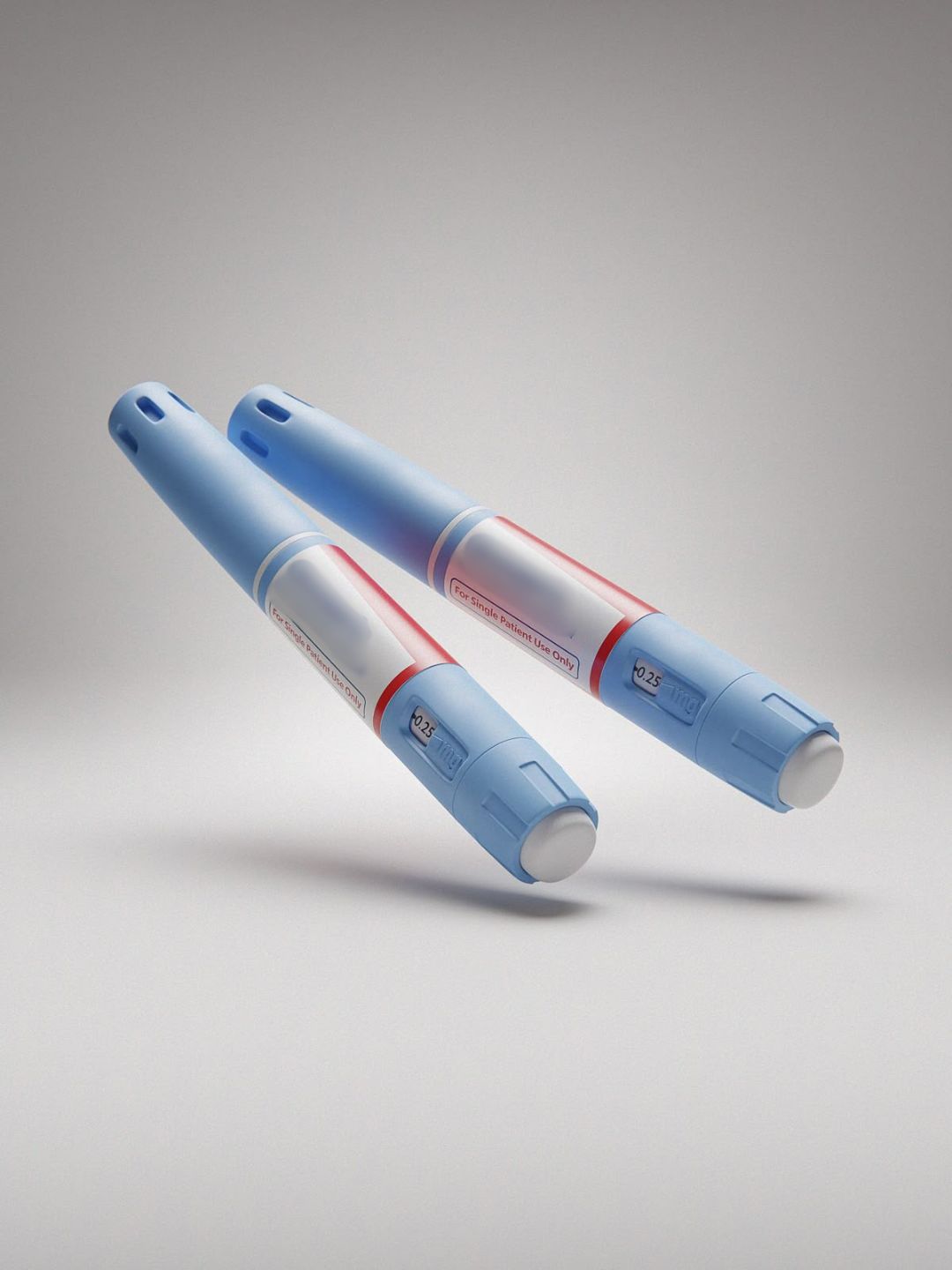
Two types of injectable medication are now widely discussed for weight management. One works on a single hormone pathway (GLP-1). The newer type works on two pathways at once (GIP and GLP-1). Wegovy (semaglutide) is an example of the first; Mounjaro (tirzepatide) is an example of the second.
This article explains how they differ in mechanism, what published trials report, and what proper medical use involves.
How do these medications work in the first place?
Your gut releases hormones after you eat that help control appetite and blood sugar. GLP-1 (glucagon-like peptide-1) reduces appetite, increases the feeling of fullness, slows how quickly the stomach empties, and helps regulate insulin. GIP (glucose-dependent insulinotropic polypeptide) is a second gut hormone involved in insulin response and fat metabolism.
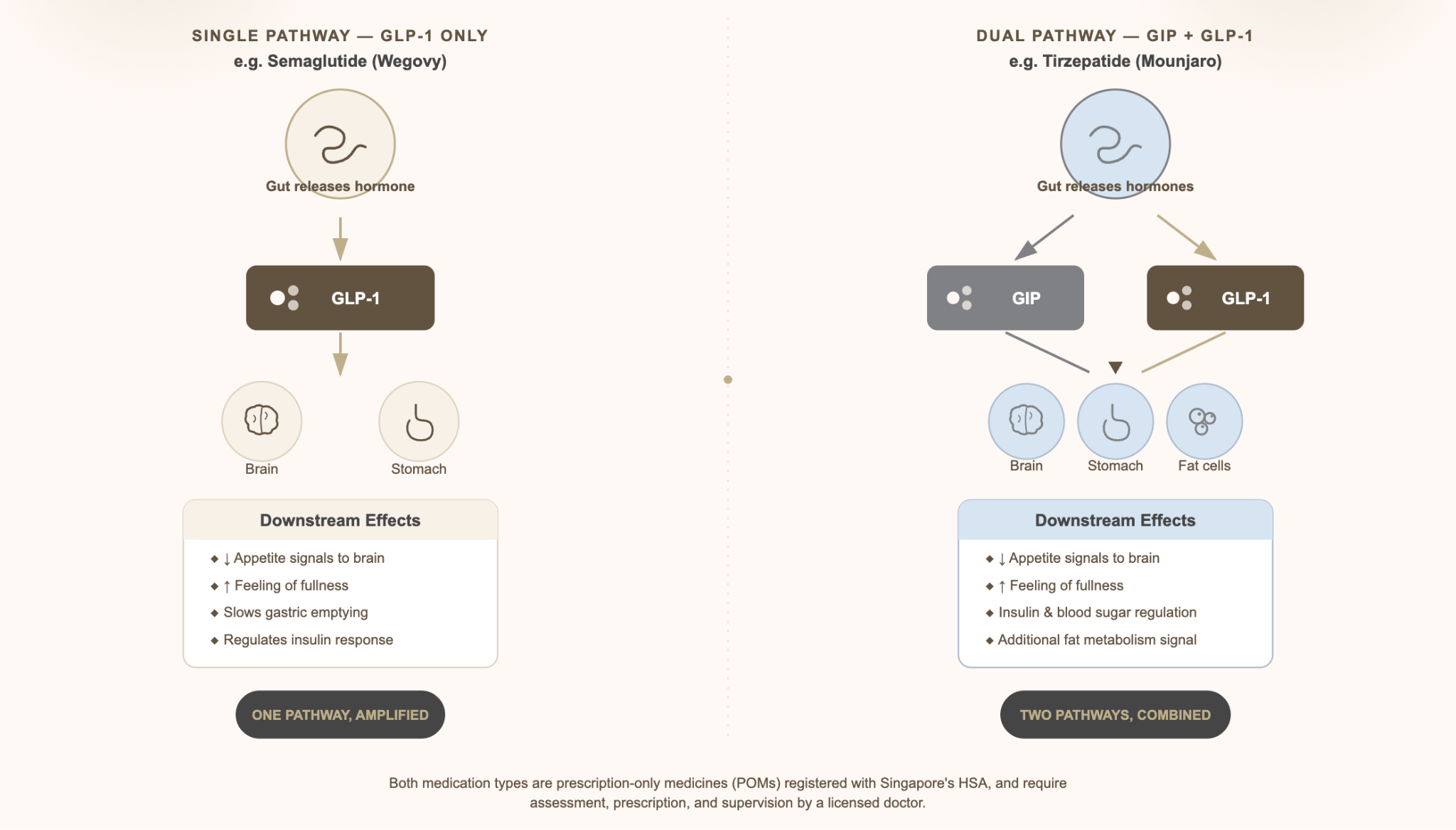
The medications in this category are "receptor agonists". They mimic these hormones to amplify their natural effects.
What is a GLP-1 receptor agonist?
Semaglutide, the active medication in Wegovy (and Ozempic), is a GLP-1 receptor agonist that acts on the GLP-1 pathway. It has been used frequently to assist weight management. It works by mimicking the natural gut hormone GLP-1, which slows digestion and acts on areas of the brain that regulate appetite and the feeling of fullness. It is given as a once-weekly injection, started at a low dose and increased gradually over several weeks to reduce side effects.
What is a dual GIP/GLP-1 receptor agonist, and how is it different?
Tirzepatide, the active ingredient in Mounjaro, is a dual agonist that acts on both the GIP and GLP-1 pathways at the same time. By mimicking two gut hormones rather than one, it acts on appetite and on blood sugar regulation, and the idea is that the effects may be additive compared with a single pathway. Clinical trials report average weight loss of roughly 15% to 20% of body weight over the study periods, slightly higher than single GLP-1 agonists. It is also a once-weekly injection with a gradual dose increase.
What does the published trial evidence show?
In the STEP-1 trial (semaglutide 2.4 mg, published in the New England Journal of Medicine, 2021), participants saw an average weight reduction of around 15% over 68 weeks, compared with about 2.4% on placebo. In the SURMOUNT-1 trial (tirzepatide), the higher dose was associated with an average reduction of around 21% over 72 weeks. A head-to-head trial, SURMOUNT-5, reported greater average weight reduction with tirzepatide than with semaglutide (approximately 20% versus 14%).
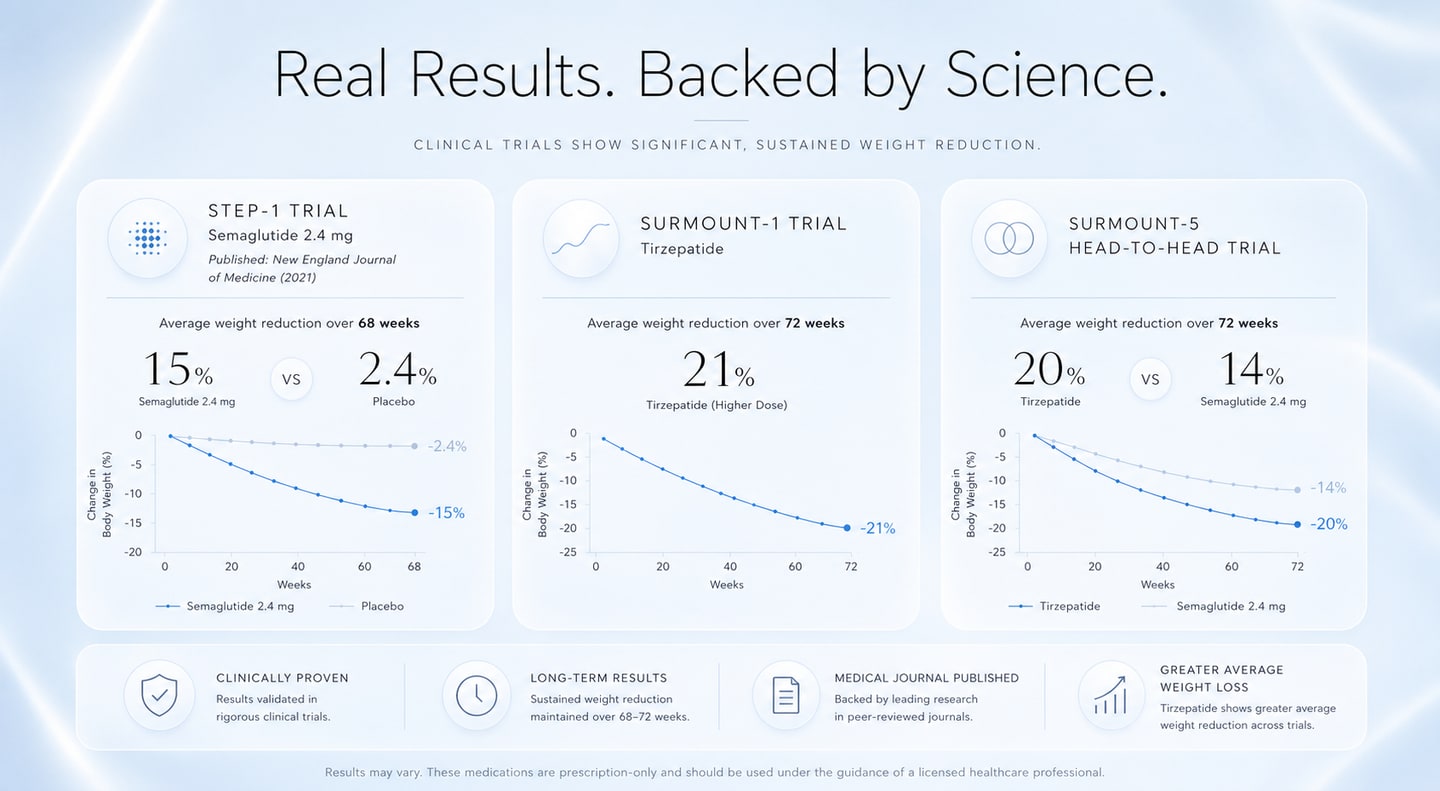
STEP-1
~15%
Semaglutide 2.4 mg
Average weight reduction over 68 weeks, compared with about 2.4% on placebo.
New England Journal of Medicine, 2021
SURMOUNT-1
~21%
Tirzepatide (higher dose)
Average weight reduction over 72 weeks in the study population.
Published trial data
SURMOUNT-5
~20% vs ~14%
Head-to-head comparison
Greater average reduction with tirzepatide than with semaglutide.
Head-to-head trial
These are study figures, not guarantees. Trial averages describe groups, not any one person.
Two caveats. First, trial averages describe groups, not any one person, and individual results vary widely. Second, both medications were studied as an adjunct to a reduced-calorie diet and increased physical activity, not as a replacement for them.
What are the side effects?
Both types share a broadly similar side-effect profile. The common ones are nausea, vomiting, diarrhoea or constipation, fatigue, headache, and injection-site reactions, which often ease as the dose is increased slowly. Less common but serious risks include pancreatitis and gallbladder problems. Both medications also carry a warning regarding a type of thyroid tumour seen in animal studies, the human relevance of which is not established. People with a personal or family history of medullary thyroid cancer or MEN2 syndrome, and those with certain other conditions, are generally not suitable.
In Singapore, these medications require a doctor's assessment, monitoring, and prescription.
Who are these medications for?
Originally used for diabetes control, they have been studied and approved for obesity, or with overweight plus a weight-related health condition, as part of a supervised plan that also includes diet and activity changes. They are not suitable for everyone. A licensed doctor weighs your full medical history, current medications, and risk factors before considering whether either type is appropriate. They are not cosmetic products and not a quick fix.
How are they used properly?
Proper use rests on three things: assessment before starting, a dose that increases gradually, and review that continues throughout.
Supervised use
Three things proper use depends on
Prescription & assessment
In Singapore these are prescription-only medicines, so a doctor must assess suitability first.
Gradual titration
The dose is increased step by step to manage side effects.
Ongoing supervision
Regular review to check tolerance, response, and safety, and to support lifestyle changes.
Frequently asked questions
What is the main difference between a GLP-1 and a dual GIP/GLP-1 weight management injection?
A GLP-1 receptor agonist acts on a single hormone pathway, while a dual GIP/GLP-1 receptor agonist acts on two at once. Semaglutide (Wegovy) is an example of the first; tirzepatide (Mounjaro) is an example of the second. The clinical relevance of that difference is assessed by a doctor for each individual.
Do these injections need a prescription in Singapore?
Yes. Both are prescription-only medicines registered with the HSA. They cannot be obtained over the counter or without a doctor's assessment, prescription, and supervision.
How much weight can someone expect to lose?
Published trials reported average reductions of roughly 15% (semaglutide, STEP-1) and around 21% (tirzepatide, SURMOUNT-1) over study periods of 68 to 72 weeks, alongside diet and activity changes. These are group averages from research, not individual guarantees, and results vary considerably.
What are the most common side effects?
Nausea, vomiting, and other digestive symptoms are the most common and often ease with gradual dose increases. Less common but serious risks exist, which is why medical supervision is essential.
Who should not use these medications?
They are generally unsuitable for people with a personal or family history of medullary thyroid cancer or MEN2 syndrome, a history of pancreatitis, during pregnancy or breastfeeding, and in several other situations. A doctor assesses this individually.