
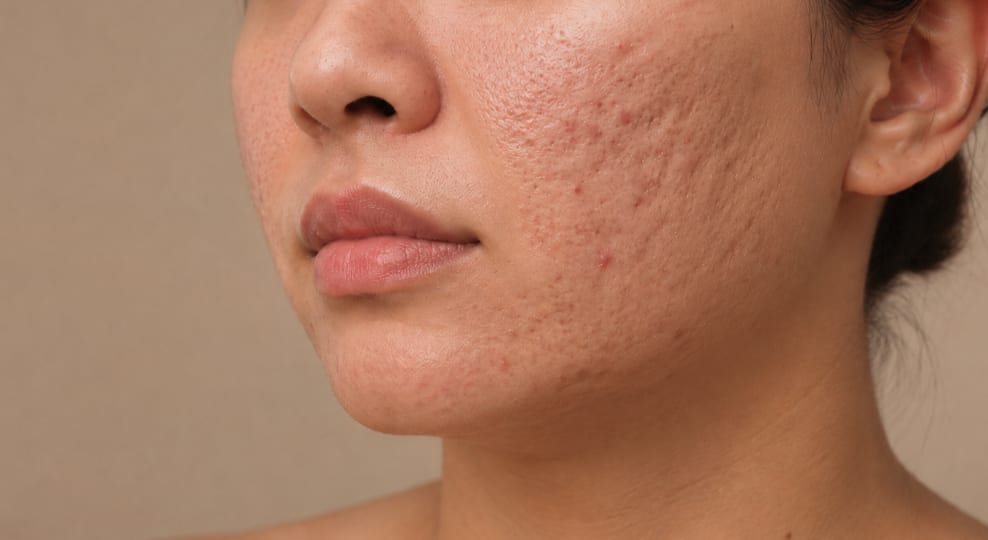
Not all acne scars are the same, and the types you have decides which treatments a doctor may consider. There are four main types: three kinds of atrophic (depressed) scar, called ice pick, boxcar, and rolling, plus raised scars, which are hypertrophic or keloid.
The flat brown or red marks left after a breakout are not textural scars, and will be considered separately. Here are some types and what treatment categories are typically used for each.
First, are they scars or marks?
Before the four scar types, there are two commonly seen skin marks after any skin injury or irritation.
Post-inflammatory hyperpigmentation
The flat brown or grey-brown marks left after a pimple settles. The skin structure is intact; this is excess pigment, not a scar, and it often fades over weeks to months with sun protection.
Post-inflammatory erythema
The flat pink or red version, caused by dilated capillaries after inflammation. It is more visible in lighter skin and also tends to fade, though slowly.
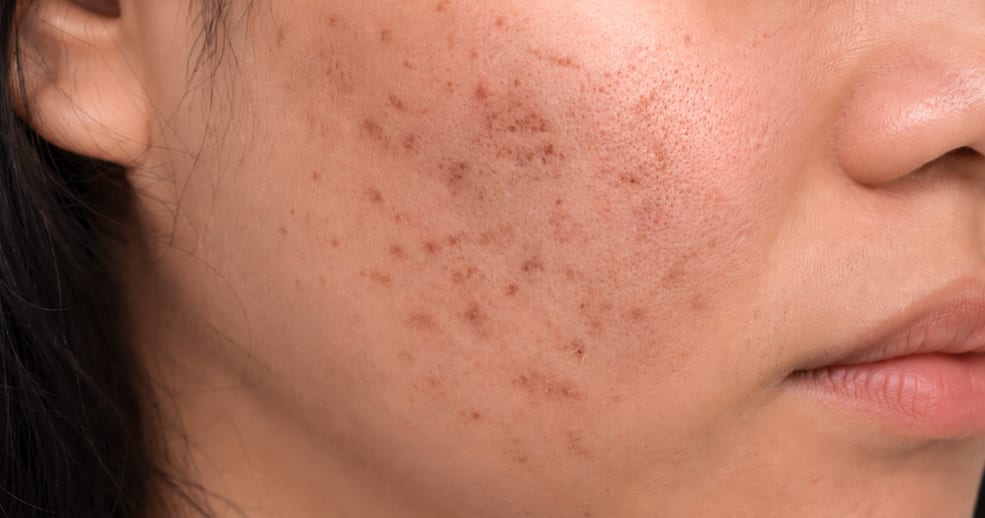
Neither is a true scar. This matters because many people chase aggressive "scar" treatments for marks that would have faded over time, while overlooking the actual textural scars underneath.
How acne scars form
True scars form when inflammation damages tissue in the dermis and subcutaneous layers. If the body makes too little collagen during healing, the skin is left with a depression, which is an atrophic scar. If it makes too much, the skin is left with a raised bump, which is a hypertrophic or keloid scar. The four types below all come from this one process going in different directions.
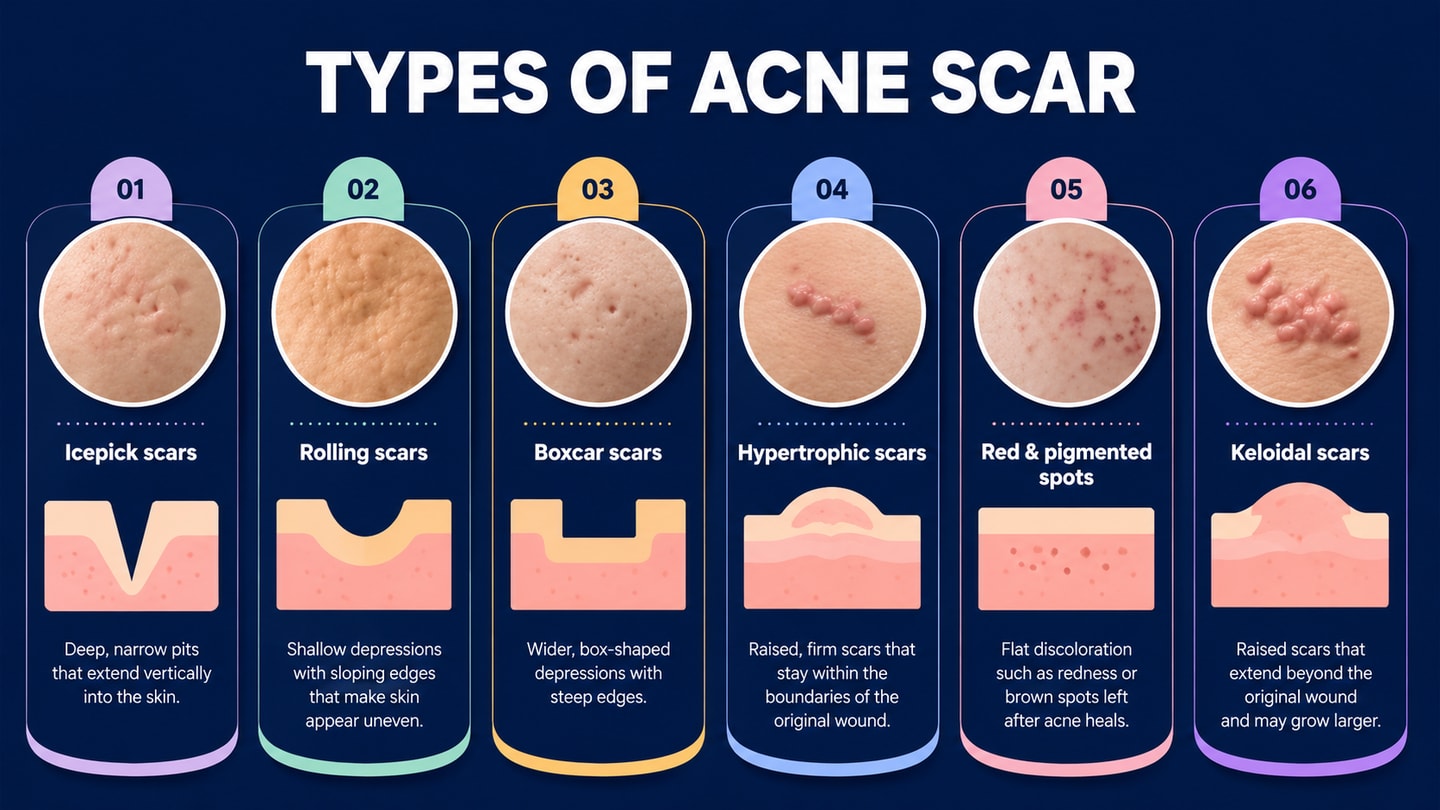
Ice pick scars
- What they look like
- Narrow, deep pits, usually less than 2mm wide, with a sharp V-shape that tapers down into the skin.
- How they form
- A deep, inflamed breakout destroys tissue in a narrow channel, and healing cannot bridge the gap.
- Treatment categories a doctor may consider
- Focal techniques such as TCA CROSS, which applies a high-strength agent into the narrow tract to stimulate collagen, and punch excision, where the tract is physically removed. Skilful use of resurfacing lasers is sometimes used to target the base. Ice pick scars are among the more technically challenging to treat, and may often have more downtime, which is one reason professional medical assessment matters.
Boxcar scars
- What they look like
- Depressions with sharp, near-vertical edges and a flat base, giving a U-shaped profile. They are usually 1.5 to 4mm wide and can be shallow or deep.
- How they form
- Inflammation destroys a broader patch of collagen, leaving a defined crater rather than a narrow channel.
- Treatment categories a doctor may consider
- Fractional laser resurfacing, RF microneedling, and subcision combined with various injectable biostimulators, polynucleotides, collagen, or fillers to restore lost volume and remodel the scars. Shallow boxcar scars generally respond better than deep ones, and a combination of treatments is common.
Rolling scars
- What they look like
- Broad, wave-like undulations wider than about 4 to 5mm, with sloping, blurry edges that give the skin a rolling appearance, often on the lower cheeks and jawline.
- How they form
- Inflammation causes tissue loss, and fibrous bands tether the skin down to the deeper tissue, pulling the surface into dips even though the surface skin itself is relatively normal.
- Treatment categories a doctor may consider
- If appropriate, subcision is the most targeted approach, using a needle or cannula to release those tethering bands so the skin can lift. This procedure is highly doctor dependent, with various degrees of subcision and techniques. RF microneedling, laser, and other injectables are often used alongside it to improve surface texture. Results build over months as the released tissue remodels.
Hypertrophic and keloid scars
- What they look like
- Firm, raised, pink to dark bumps of excess scar tissue. A hypertrophic scar stays within the original spot's boundary. A keloid grows beyond it and can keep enlarging, and is more common in darker skin tones.
- How they form
- The healing process overproduces collagen, building unorganised tissue up inappropriately.
- Treatment categories a doctor may consider
- Intralesional corticosteroid and other injections to calm the overgrowth, certain lasers to address redness and pliability, silicone gel sheets as support, and surgery for large keloids, usually combined with another treatment to reduce recurrence. This is a completely different approach from atrophic scars, which is why correct identification comes first.
Why getting the type right is harder than it looks
Many people have more than one type, with different severities and depths at once. Every person's health status, skin quality and type also varies greatly. An accurate assessment of your scar mix is what makes a treatment plan work.
Acne scar treatment at Reborn Skin Clinic
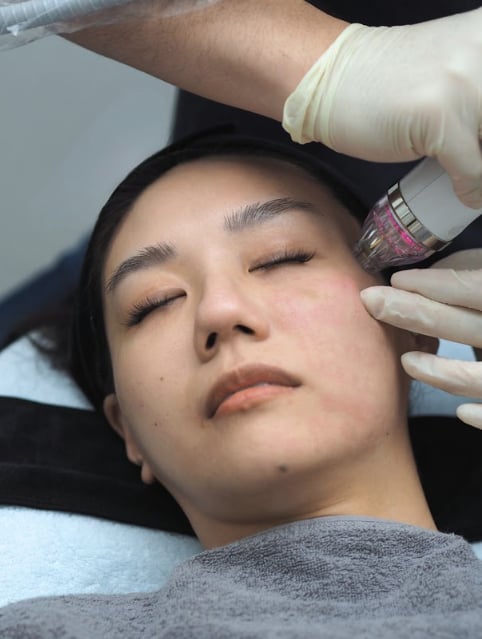
Because most people present with a mix of scar types, Reborn's approach starts with our doctor assessing which types you have before recommending anything. Depending on your needs and personal schedule, that may involve subcision for rolling scars, laser or RF microneedling for atrophic scars and texture, and various skin boosters, healers and biostimulators. Treatment of acne scars is a slow process that gradually improves over multiple well-designed programs and procedures. You can read more on the acne scars concern page, and if you want a clear read on your own scars, you can request a consultation. Active acne is usually brought under control first, since treating scars while breakouts continue tends to work against the result.
Frequently asked questions
What are the main types of acne scars?
There are four: ice pick (narrow, deep pits), boxcar (broad depressions with defined edges), rolling (wave-like undulations from tethering below the skin), and raised hypertrophic or keloid scars. Flat brown marks after acne are post-inflammatory hyperpigmentation, which is not a scar.
How do I know which type of acne scar I have?
Each has a distinct shape: ice pick is a narrow V, boxcar a broader U, and rolling depressed wave. That said, many people have more than one type, and accurate identification is best done by a doctor who can assess depth and distribution before recommending treatment.
Do acne scars go away on their own?
Flat marks (PIH and PIE) may fade over weeks to months with sun protection, or can be sped up with treatment. Textural scars usually do not resolve without treatment. How much they can improve depends on the type, depth, and approach used.
How many sessions does acne scar treatment take?
It varies with scar type, depth, and the treatments used. Deeper, older scars generally need several sessions over months, and results build gradually rather than appearing after one visit. A doctor outlines a realistic timeline at consultation.